
Legend
This page summarizes the registration process for musical instruments in the collection and shows how the information is presented in our database.
Note that the following text is a revision of our collection catalogue, originally published in 1996.
Foreword
Our database comprises accounts on the musical instruments in possession of the Gakkigaku Shiryōkan (Collection for Organology), Kunitachi College of Music. Since proper understanding of musical instruments can hardly be attained only by means of names and illustrative descriptions, photographs accompany every instrument listed in this database. In these photographs the instruments have been placed, as far as has been practical, in a position as close to that used in actual performance, so that the view given is that perceived by a listener.
A ruler of 60 cm in length in each photograph serves to show the approximate size of the instrument.

Accounts on each instrument have been kept to a minimum. Priority has been given to the use of names listed in Sibyl Marcuse, ed. Musical Instruments: A Comprehensive Dictionary (New York: Norton, 1975) and Stanley Sadie, ed. The New Grove Dictionary of Musical Instruments (London: Macmillan, 1984) in order to facilitate reference to these dictionaries. The contents, based on the systematics, or system for classification, of the instruments which is to be dealt with below, is divided into the following six chapters according to the form of the vibrating body.
- Massophone (massa, ‘solid’)
- Cupophone (cupa, ‘hollow solid’)
- Clavophone (clava, ‘stick’)
- Tabulophone (tabula, ‘board’)
- Chordophone (chorda, ‘string’)
- Membranophone (membrana, ‘membrane’)
In each chapter instruments are arranged according to the third item of the systematics i.e. types of source for vibration of the vibrating body, consisting of:
- Percussion
- Friction
- Plucking
- Air current
- Electronic oscillation
Instruments with the same vibration source are arranged according to their physical shapes.
In our Collection, damaged instruments have been repaired, restored or conserved as they stand.
Legend
1.Registered number
Each musical instrument is given a registered number on acquisition. The latest number as of the end of March 2022 is 2590. With regard to instruments that have apparently been mass-produced according to a fixed standard, only one of them has been shown in our database, with the registered numbers of all identical instruments listed together.
2.Systematic number
Systematic numbers are composed of seven figures; each figure corresponds to the following items:
- 1st figure: Form of the vibrating body
- 2nd figure: Material of the vibrating body 5(4) = 5and4
- 3rd figure: Source of vibration
- 4th figure: Application of vibration 1(2) = 1and2
- 5th figure: Conversion of vibration
- 6th figure: Form of converting part
- 7th figure: Material of converting part
See “Systematics”
3.Name
Names used in this catalogue are mainly drawn from two sources: Musical Instruments: A Comprehensive Dictionary and The New Grove Dictionary of Musical Instruments. Abbreviations indicating these sources are shown in the square boxes attached to the names of instruments.
Napura![[Marcuse]](/en/collection/legend/img/img_legend_M.png) Nupur Nupur![[Grove]](/en/collection/legend/img/img_legend_G.png) |
both names can be referred to in Marcuse and Grove |
|---|---|
| Trombita |
can be referred to in both Marcuse and Grove |
| Ranasringa |
can be referred to only in Marcuse |
| Zilli masa |
can be referred to only in Grove |
Musical instruments not included in these two sources are given names in common use.
4.Regional name
Names of musical instruments among various ethnic groups in the world have, starting from an original form, undergone transitional changes in terms of period and region. Therefore, it is no rare case to find out that one single instrument carries a multiplicity of names. In addition, there are innumerable cases of discrepancies between actual sound and Romanized transcriptions that occur when the names of instruments of various ethnic groups are transcribed into roman letters. Under these circumstances it is almost impossible to cover all the regional names in this catalogue.
Regional names listed in this catalogue are confined to those of the instruments that have been confirmed by reference to photographs or charts of the corresponding instruments in publications of national or public museums, archives and institutes of the regions to which the instrument belongs.
5.Region
The names of countries and regions include names and regional divisions that are not currently used. (Ex. Soviet Union, etc.)
About instruments with a clear date of production, the name at the time of production is also used.
The following regional divisions have been applied to those instruments the specific regions of which remain unclear:
- East Asia
- Southeast Asia
- South Asia
- Southwest Asia
- Africa
- Former U.S.S.R.
- Europe
- North America
- South America
- Oceania
- Antarctic
6.Maker
In addition to individual names, the entry for maker includes names of factories, companies, and agents.
7.Date
Approximate date is designated by c. (circa), while C. stands for century. Concerning those instruments that were new at the time of purchase, the year of purchase is considered to be the year of manufacture, even if the maker is not identified.
8.Note
| Tonal range | soprano, alto, etc. |
|---|---|
| Pitch name | 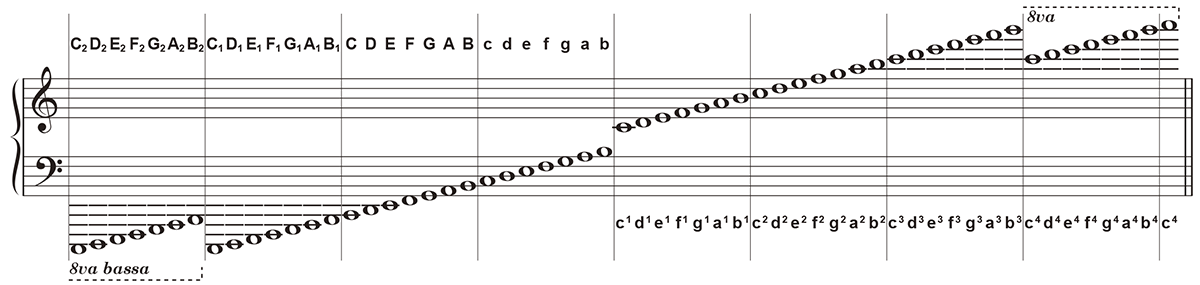 |
| Structure | ex. Unfretted, Historically significant construction |
| Reproduction | When an identifiable instrument is reproduced, the maker of the original instrument and the data are shown alongside with the sign Mod. (Model). Otherwise the sign Reproduction only has been used. |
| Restoration | When an instrument has undergone any major restoration, the person or organization (ex. K.C.M. [Kunitachi College of Music]) is specified. |